
A Beginners’s Guide to the Basics of Rugby Union Positions

In the game of rugby union which is a contact team sport, there are 15 players in each team, consisting eight forwards (numbered 1–8) and seven backs (numbered 9–15). Additionally, there can be up to eight replacement players “on the bench”. Jersey numbers 16–23 are used to distinguish them. Players are not confined to any single position on the field, even though they mostly focus in only one or two that suit their skills and body types. Players who train in over three positions are called “utility players”. The scrum (an assemblage used to restart play), however should consist of eight players (if a team still has fifteen on the field); three in the front row, two in the second and three at the rear.

The positions as given by the International Rugby Board are full-back, wings (left and right), centres (inside and outside), fly-half, scrum-half, number eight, flanker (openside and blindside), lock, hooker and props (loosehead and tighthead). The names have changed with time and geography. Initial names such as “three-quarters” and “out-halves” are still used by a few people, while in New Zealand the fly-half and inside centre are called “first five-eighth” and “second five-eighth” respectively, while the scrum-half is recognized as the half-back. Besides, there are many names for different groupings of players: the “front row” is the two props and the hooker; the “tight five” is made up of the props, locks and hooker; the “back row”, or sometimes “loosies”, are the number eight and flankers; the “inside backs” are the scrum-half, fly-half and inside centre; the “outside backs” are the outside centre, wings and full-back; and the “back three” are the two wings and the full-back.
Also, Read – Interesting Facts About Rugby
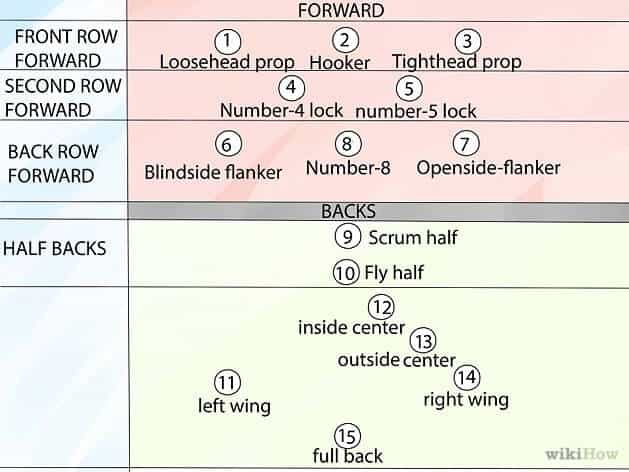
rugby positions

The backs play behind the forwards and are normally more lightly built and faster. Successful backs are skilful at passing and kicking. Full-backs need to be good defenders and kickers, and have the capability to catch a kicked ball. The wingers are generally among the fastest players in a team and score many of the team’s tries. The centres key attacking roles are to try and break through the defensive line and link successfully with wingers. The fly-half can be a good kicker and usually directs the backline. The scrum-half reclaims the ball from the forwards but needs a quick and accurate pass to get the ball to the backs (often firstly to the fly-half). Forwards compete for the ball in scrums and line-outs and are predominantly bigger and stronger than the backs. Props push in the scrums, while the hooker tries to “hook” the ball. Locks are tall and jump for the ball at the line-out after the hooker has thrown it in. The flankers and number eight should be the first forwards to a tackle and play a crucial role in obtaining possession of the ball for their team.


Latest

Capoeira: Brazil’s Martial Art That Was Hidden as a Dance

Capoeira is a Brazilian martial art created by enslaved Africans and disguised as dance to survive colonial bans. UNESCO Intangible Cultural Heritage since 2014. Here is the full history.

Chilean Rodeo: Chile’s National Sport and How It Works

Chilean rodeo is Chile's national sport since 1962. Two huaso riders guide a calf against a padded wall in a half-moon arena. Judged on precision, not speed. Here is the full guide.

Charreria: Mexico’s National Sport and UNESCO Cultural Heritage

Charreria is Mexico's national sport since 1933 and UNESCO Intangible Cultural Heritage since 2016. Nine equestrian events, the escaramuza women's competition, and a deep cultural tradition.

Dandi Biyo: Nepal’s National Sport Explained

Dandi Biyo is Nepal's traditional national sport, played with a long stick and small wooden peg. Learn how the game works, why Nepal adopted it, and how it survives today.

Newsletter

FIND YOUR PERFECT TENNIS PARTNER NEARBY IN LESS THAN 30 SECONDS

Must Check

Unlock Your Inner Yogi with the Best Yoga Pants for Women!

Yoga has become increasingly popular among women worldwide as...

Best Women’s Golf Pants: Petite, Plus Size, Jogger & Hot Weather Guide

How to find the right women's golf pants for your body type and the season — from petite and plus size fits to summer-weight fabrics and modern jogger styles.

Don't miss

Know Everything about Cave Diving

In today’s article on Adventure Sports, you will know...

13 Funny And Interesting Rugby Quotes

Interesting & Funny Rugby Quotes: "Rugby is a good occasion...

Rain seals West Indies’ fate prematurely

Sidelights – ICC World T20 | Sri Lanka Vs...

Bioluminescence Kayaking: Best Locations, When to Go and What to Expect

Where to go bioluminescence kayaking -- Puerto Rico, Florida, Jamaica and beyond. Best locations, peak season, guided vs independent paddling, and what to bring.

All about Wankhede Stadium

If the Eden Gardens is the ‘home of Indian...
Editor
David Whisler, the maestro of editing at Sportycious, brings a touch of panache to the world of sports journalism. With an eagle eye for detail and a flair for enthralling storytelling, David ensures Sportycious remains the go-to destination for readers seeking an exhilarating and enlightening experience. When not juggling commas and semicolons, you'll find David enthusiastically supporting his favourite teams and indulging in his own sporting escapades.
spot_imgspot_img

Rugby in Argentina: Los Pumas, Two World Cup Third Places, and the Sport That Defied Football

Argentina finished third at the 2007 and 2023 Rugby World Cups, beating the host nation France both times. Here is the full story of Los Pumas and rugby in Argentina.

Rugby in Italy: The 36-Match Losing Streak, Sergio Parisse, and What Came After

Italy lost 36 consecutive Six Nations matches between 2015 and 2022. Then they beat Wales 22-21. This is the full story of Italian rugby, from Sergio Parisse to the current Azzurri.

Rugby in the USA: Is It Growing, Where to Watch, and Why It Takes Time

The USA won Olympic rugby gold in 1920 and 1924. A century later, Major League Rugby launched and the sport now has 1.6 million registered players. Here is where American rugby stands.